Insights
Why Machines Need to Understand Your Products

The buyer may meet the machine before they meet you
Suppose you run a European company that makes specialist industrial equipment.
A German distributor is looking for a new supplier. A few years ago, someone on the procurement team might have searched Google, opened several company websites and downloaded a few catalogues.
Today, they can start with a much simpler request:
Find five European manufacturers of this type of equipment. Compare them. Which ones sell in Germany? Which seem most established?
Your company may be compared before anyone contacts you.
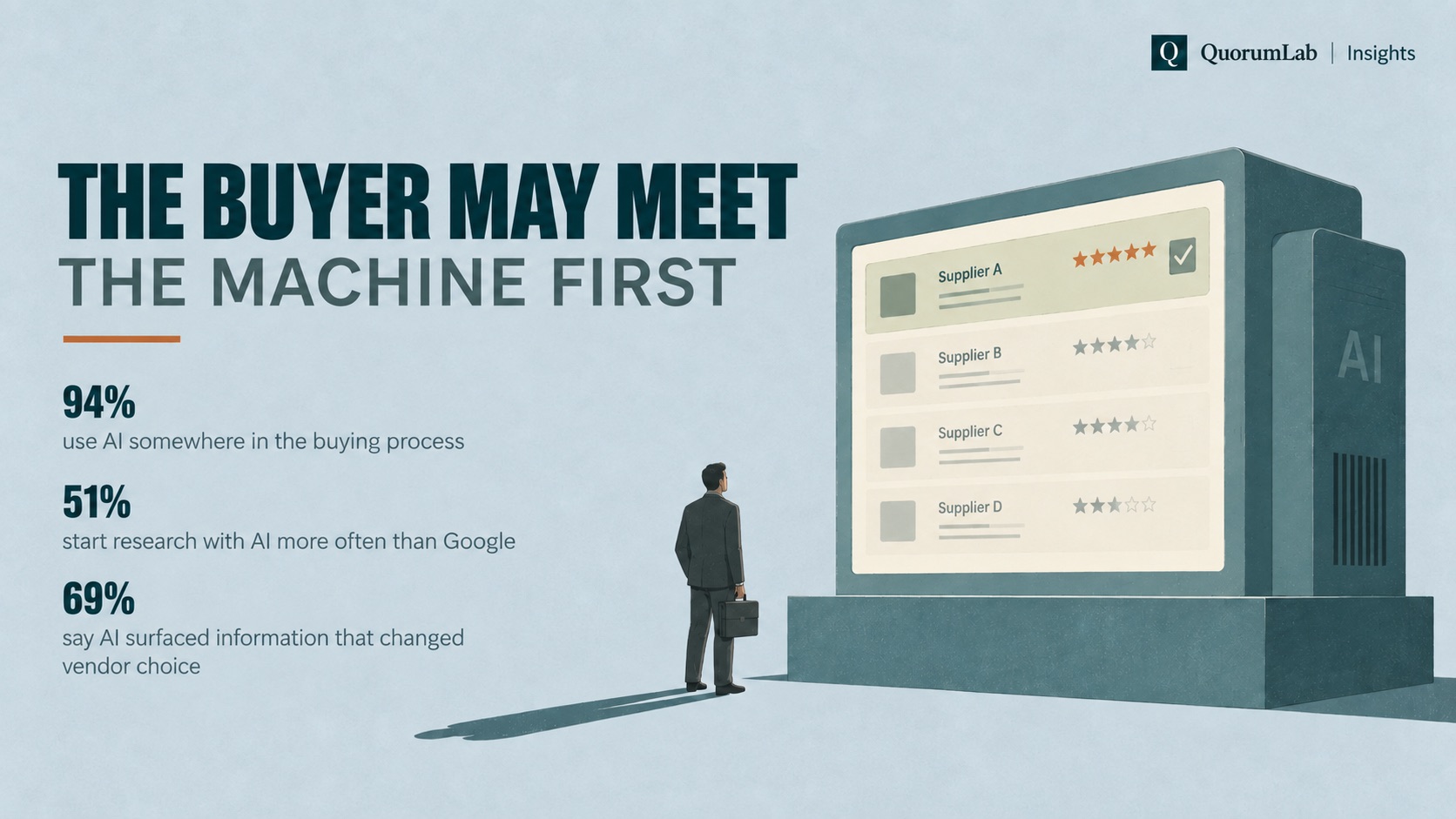
Forrester's 2026 report, based on its 2025 Buyers' Journey Survey of nearly 18,000 global business buyers, found that 94% use AI somewhere in the buying process. Buyers still check what AI tells them, but AI is now part of serious commercial research.
The effect is especially clear in software buying. In G2's survey of more than 1,000 B2B software buyers across North America, EMEA and APAC, 51% said they start research with an AI chatbot more often than with Google. Sixty-nine per cent said AI surfaced information that led them to choose a different vendor.
Those numbers are about software, not every industry. But they show that the first serious look at a supplier can now happen somewhere the supplier does not control.
When AI looks at your company, does it understand the business you are running today?
What the Digital Product Passport actually does
The Digital Product Passport, or DPP, is another sign that companies will have to get much better at making products clear to software systems.
On 20 July 2026, the European Commission made the Digital Product Passport Registry operational. The Registry was established under the EU's Ecodesign for Sustainable Products Regulation, or ESPR, while DPP requirements can also come through other EU laws.
The first mandatory passports arrive through the EU Batteries Regulation. From 18 February 2027, each electric-vehicle battery, light means of transport battery and industrial battery above 2 kWh placed on the market or put into service must have a battery passport.
For a CEO, the useful part is simpler than the legal structure.
A DPP gives a product a digital record linked to a unique identifier. The information follows common rules so that other systems can use it without somebody opening a PDF, guessing which model the company means or working out whether two names refer to the same product.
The EU Registry does not hold every product detail in one giant database. Detailed information remains decentralised, while the Registry stores identifiers, registration information and high-level metadata.
Europe wants products to be easier for software systems to identify and understand.
How one company becomes several companies online
This sounds simple until you look at how product information actually lives inside a growing business.
Marketing updates the website. Sales keeps the latest PDF. A distributor has its own catalogue. The German team changed the product name last spring. The Italian site still uses the old one.
For people inside the company, this may feel manageable. Machines do not know the backstory. They see what is available.
Take a fictional manufacturer that changed its corporate name and launched a new product range. Its own website is current. A large distributor still uses the old brand. Trade articles connect the products to the previous legal entity. A directory still presents a discontinued model as the company's main product.
Now ask an AI system a few ordinary questions:
- Who makes this product?
- Is Brand A the same company as Company B?
- What is the manufacturer's current product line?
- Does the company sell in Germany?
The system has to rebuild the picture from those scattered pieces.
Sometimes it will get it right. Sometimes it will not. And sometimes the answer will contain no obvious falsehood but still leave the buyer with the wrong impression.
AI does not need to invent a false fact to present a company badly. A weak picture can be built entirely from facts that are individually true.
DPP and AI visibility: similar discipline, different jobs
A Digital Product Passport and AI visibility are not the same thing.
| Question | AI visibility | Digital Product Passport |
|---|---|---|
| What is the problem? | How AI systems understand and present a company, product or person | How required product information is identified, structured and exchanged |
| Why can it matter? | Discovery, comparison, trust and supplier evaluation | Compliance, traceability, transparency and product-data exchange |
| Where does trouble come from? | Old names, conflicting sources, unclear relationships, weak or missing information | Missing, inaccurate or inconsistent required product data |
| What does it guarantee? | No specific answer or recommendation from an external AI system | No improvement in what ChatGPT or another AI system says about the company |
| What useful habit do both reward? | Keeping identities, relationships and external information clear | Keeping product information structured, current and unambiguous |
A company should not create a DPP because it wants better answers from ChatGPT. There is no evidence that the two work that way.
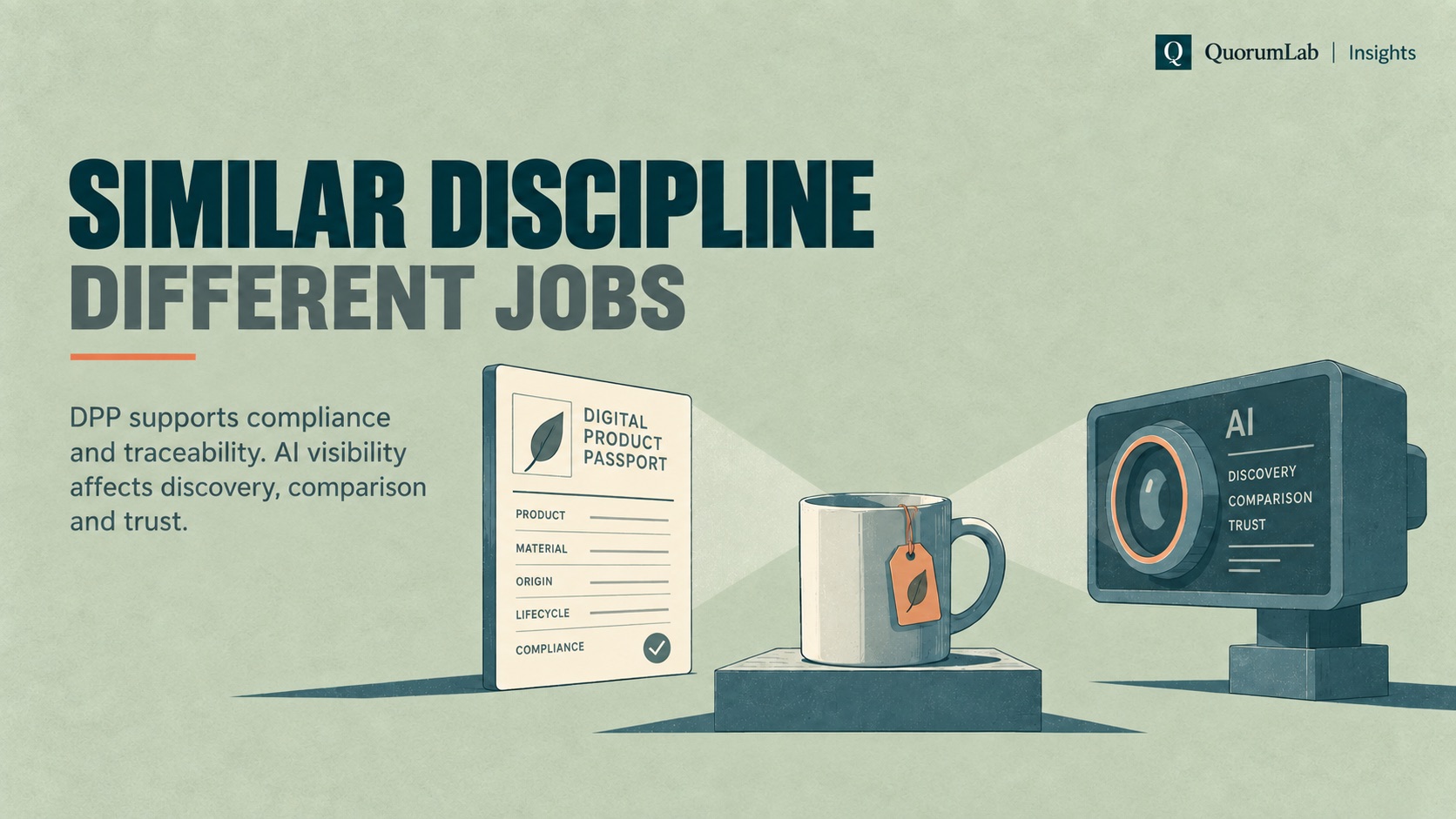
The connection is simpler. If product data is old, contradictory or scattered, preparing for DPP becomes harder. If the company, brand and products are described inconsistently across the web, AI systems may also struggle to build a clear picture.
The same mess can hurt you in two different places.
The European Commission is already advising affected economic operators to prepare. The current ESPR Working Plan points to product-specific rules for iron and steel in 2026; textiles, tyres and aluminium in 2027; furniture in 2028; and mattresses and ICT products in 2029.
These are not dates when every company in those sectors suddenly needs a DPP. They are the Commission's indicative timetable for developing the rules. Once an ESPR delegated act is adopted, businesses are generally given at least 18 months to prepare.
What should a CEO check now?
You do not need to start with a large technology project. A quick outside-in check can already tell you a lot.
- Does the company use the same name everywhere that matters?
- Can an outsider clearly tell the company, brand, manufacturer, seller and legal entity apart?
- Are old products or old company names easier to find than the current ones?
- Do major distributors and independent sources describe the business and its products correctly?
- When several AI systems are asked the same business questions, what keeps coming back?
The fifth question needs care.
One strange answer from ChatGPT is not a diagnosis. It does not prove that your website is wrong, that you need more PR or that you need Wikipedia. One answer is simply an observation.
If the same problem keeps appearing across different prompts, systems or repeated checks, then you have something worth investigating.
That distinction can save money. Otherwise, a company may fix the first thing it recognises instead of the part that is actually creating the problem.
Where QuorumLab fits
QuorumLab works with the gap between the company you know internally and the picture AI systems can build from outside.
The first job is to measure what is actually being shown. Then comes the harder question: why?
The answer may involve the website, old sources, weak links between entities or differences between languages and markets.
Sometimes the task is already clear and one specific service is enough. When the symptom is visible but the cause is not, QuorumLab uses its Navigational Method: measure the current picture, map the possible causes, change what can reasonably be changed, then measure again.
The order matters. We do not see one poor AI answer and decide that the company needs a new website. We do not promise to “fix ChatGPT”. And we do not claim that a cleaner Digital Product Passport will automatically improve AI visibility.
Frequently asked questions
What is a Digital Product Passport?
A Digital Product Passport is a digital record linked to a product through a unique identifier. The exact information depends on the product rules. The EU is introducing DPP requirements gradually so relevant information can be shared and checked more reliably.
When will Digital Product Passports become mandatory in the EU?
There is no single deadline for every product. The first mandatory battery passports arrive on 18 February 2027 under the separate EU Batteries Regulation. Other product groups will follow under their own rules, so companies need to check the timetable for their own products rather than rely on one EU-wide date.
Will a Digital Product Passport improve what ChatGPT says about my company?
Not automatically. The DPP was not built as an AI visibility tool, and there is no guarantee that creating one will change an answer from ChatGPT, Gemini or another AI system. The overlap is that both areas work better when product identities, company relationships and important facts are clear and consistent.
Why should a smaller company care before DPP becomes mandatory?
Because cleaning up the underlying information can be useful before any deadline arrives. A company may discover old product names, conflicting distributor information or fragmented records. The Commission is already advising affected businesses to prepare, while some of the same problems may affect how AI understands the company today.
Does every EU company need a Digital Product Passport?
No. DPP requirements depend on the product and the legislation covering it. Manufacturers, importers, distributors and other operators may be affected, depending on the rules. A company needs to check its own products.
The bottom line
The Digital Product Passport is a compliance project, but it also exposes a broader management problem: products need clear identities and reliable information that other systems can understand.
AI creates a second reason to care. A buyer may ask a machine about your company before visiting your website.
So there is one useful question to ask now:
If a machine had to understand our business today, would it get the right company and the right products?
For some businesses, that already affects who gets considered and who gets the next conversation.