
Already know what you need?
Go directly to the relevant service.
02HOW WE WORK
AI may use an old company name, confuse a brand with a legal entity, miss a new product or describe the same business differently across languages.
That tells you what happened. It does not, by itself, tell you why.
QuorumLab starts by identifying what kind of task we are dealing with.
If the task is already clear, we can go directly to the relevant work: review a website and its data, work with Wikidata, assess notability under Wikipedia rules, investigate Reddit or measure current AI Visibility.
If the symptom is visible but the cause is not, we use the Navigational Method.
01
What shapes the picture AI presents
AI does not see a company through its website alone. The picture can be shaped by websites, data, brands, products, people, independent sources, public discussions and the connections between them.
At QuorumLab, we call this environment the machine layer.
Not every layer matters in every project. Our job is to identify what is actually relevant to the problem rather than work on everything at once.
02
When the symptom is visible but the cause is not
The Navigational Method is not the starting point for every project.
It is used when the result can already be seen, but the reason behind it has not yet been established.
We establish what picture AI presents now.
A single answer is an observation, not a stable measurement. Depending on the task, measurement may involve several queries, systems, languages or conditions.
This creates a starting point against which later changes can be compared.
We investigate what may be shaping that picture.
Where do old details still appear? Which sources contradict one another? Are the company, brand and product connected clearly? What evidence is missing?
At this stage, it is important to separate an established fact from a hypothesis about the cause.
We may be able to see the error clearly while still not knowing what is producing it.
We choose an intervention that is supported by the evidence.
This may involve the website, structured data, Wikidata, external sources, Reddit or another part of the machine layer.
If the task involves Wikipedia, we assess the notability of the company or person under Wikipedia rules and the strength of the independent sources available.
Sometimes the investigation shows that the tool that seemed obvious at the beginning is not needed at all.
After the change, we measure again.
What changed? What stayed the same? Did the confusion disappear? Is the new product now represented more clearly?
Repeat measurement shows what happened after the intervention.
It does not, on its own, prove causation. But without it, there is no sound basis for assessing whether the intervention had an effect.
If the change produces a useful result, that informs the next decision.
If it does not, we return to the map, review the hypothesis and adjust the route.
That is the purpose of the method: less guesswork, less unnecessary work and less risk of fixing the wrong thing.
03
QuorumLab distinguishes between:
This protects against two common mistakes: treating one unusual answer as a stable problem, or assuming that a later change in the answer proves what caused it.
04
QuorumLab uses its own research platform to support repeatable measurement and comparison.
It is not a separate SaaS product for clients and it does not “fix ChatGPT”.
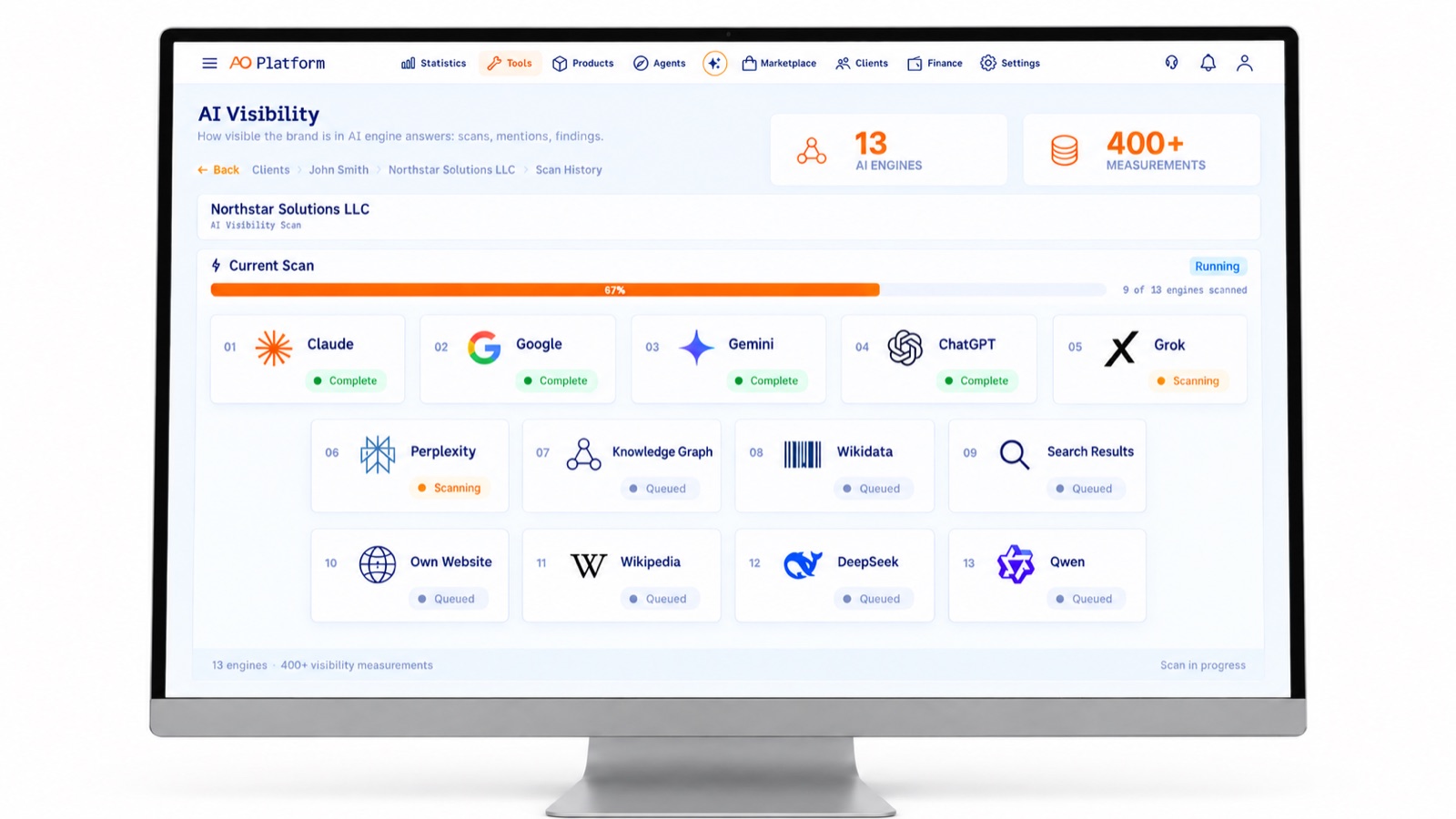
It makes measurement more consistent and comparable. The platform does not make decisions on its own. The team does.
05
Different causes require different expertise.
One task may be about the website and data. Another may involve Wikidata. A third may require work around Wikipedia notability, Reddit, independent sources, or several languages and markets at the same time.
We bring in only the expertise needed for the next justified step.
Sometimes one specialist is enough. Sometimes several areas of expertise are needed together.
Exactly as much expertise as the task requires.
06
QuorumLab works with what can be examined and changed on a sound basis: websites and data, connections between companies, brands, products and people, Wikidata, independent sources, Reddit and other relevant parts of the public information environment.
But we do not control external AI systems.
What we can define in advance is the scope of work, what the client will receive and how the result will be checked where it can be measured.
The goal is not to make AI say what a client wants to hear. The goal is to make the picture more accurate, clearer and better connected to verifiable facts.
07
Not every difficult project is R&D.
If the task is clear and the required work is already known, it can be handled as a normal service.
But where there is genuine uncertainty, a research question, a hypothesis that needs to be tested and an outcome that must be measured, the work may move into a separate R&D project.
08
Go directly to the relevant service.
Run a limited demo check using your own company or organisation. We review one or two relevant queries and send you two concise briefs.
COMMUNICATIONS BRIEF
What appears clear, weak, outdated or contradictory in the AI representation.
TECHNICAL BRIEF
Technical, structural and information signals that may need attention.
This is a demonstration format, not a full AI Visibility Baseline and not proof of what is causing the problem.