Insights
Can AI Tell Your Hotel Apart?


The hotel that never made the shortlist
Imagine a couple planning four days in Crete.
They want a quiet hotel near the sea. Good breakfast, parking, reliable Wi-Fi, no huge all-inclusive complex. Their budget is €250 a night.
Instead of opening twenty tabs, they ask an AI assistant:
“Find five smaller hotels in Crete that fit these conditions. Compare them and tell me which ones are worth looking at.”
Five hotels appear. A sixth property fits just as well, but never reaches the list.
The hotel owner will not see an abandoned booking, a lost lead or even a website visit. The traveller simply never got that far.
That is the new commercial question: what happens when a machine helps decide which hotels deserve a closer look?
AI is already part of travel planning
Travellers have not handed their holidays over to autonomous agents. But AI is already much closer to the buying decision.
Booking.com’s 2025 Global AI Sentiment Report surveyed 37,325 people across 33 markets. Two in three respondents had already used AI in some part of travel, while 89% said they wanted to use it in future trip planning. Only 12% felt comfortable with AI making decisions independently.
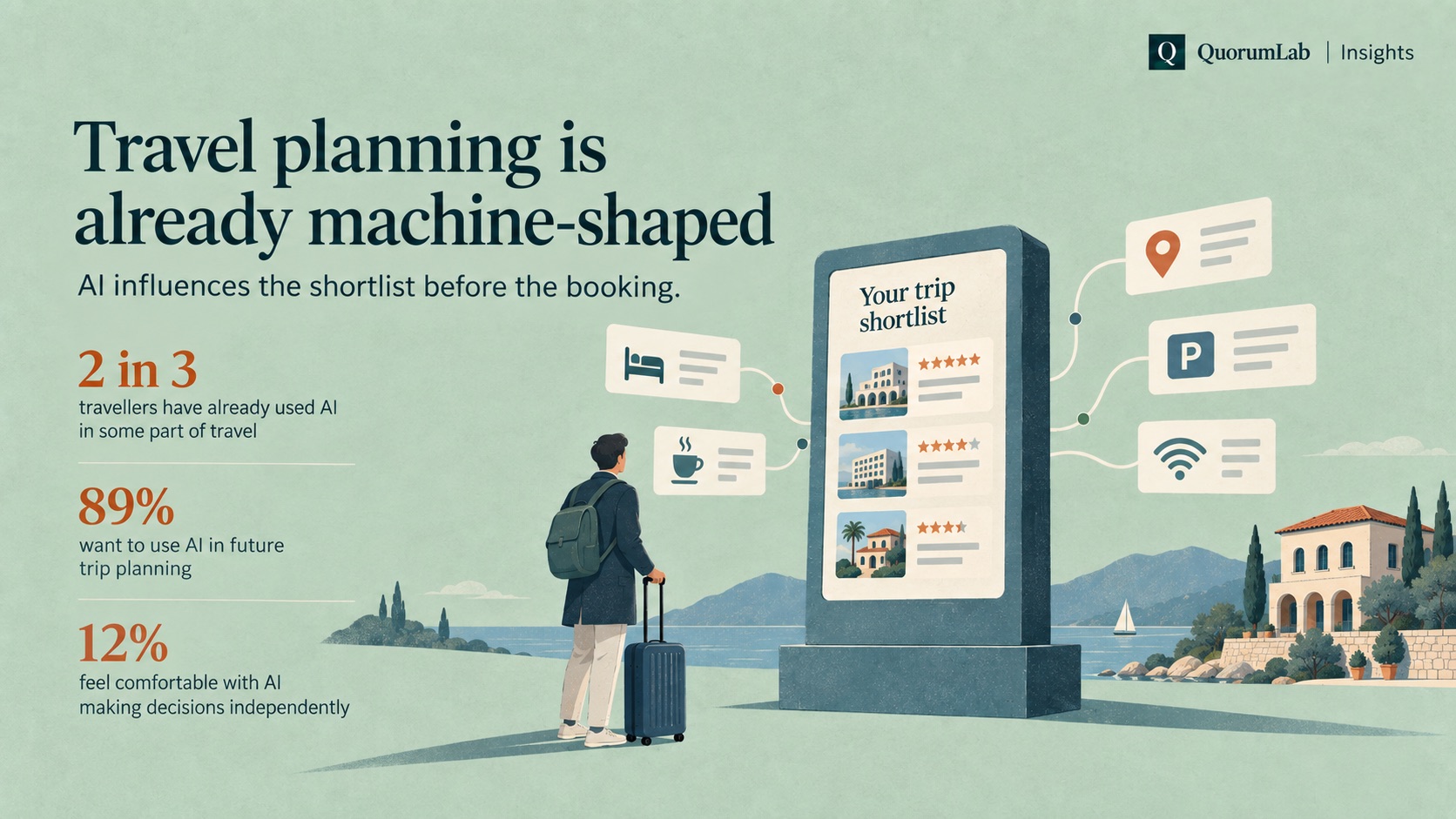
For hotels, that distinction matters. AI does not need to complete the reservation to influence the sale. It only needs to shape which properties are considered.
Before a hotel can be recommended, it has to be identified
Hotel discovery can be reduced to three steps:
Identity → Fit → Visibility
First: Which hotel is this?
Then: Does it fit what the traveller asked for?
Only then: Does it appear in the answer?
Much of the conversation about AI search jumps straight to the third step. If a system is uncertain about the property itself, that question starts too late.
One hotel may exist in many places at once: its own website, Google Maps, Booking.com, Expedia, TripAdvisor, tourism portals and several language versions.
The owner sees one property. Software has to establish that the records belong together.
Why hotels are unusually easy to confuse
Hotels create an unusually messy identity problem because names, brands and descriptions often overlap.
Think about the language of the industry: Grand Hotel, Royal Palace, Beach Resort, Boutique Hotel, Luxury Resort, Spa Hotel. The same descriptors appear everywhere.
That does not prove that the word “Luxury” makes AI confuse one hotel with another. The broader problem is that one property can have an official name, a short name, a chain brand, an operator, a former name and different versions across travel platforms.
The Boutique Hotel AI Index ran into this problem at research scale. Across 28,600 AI answers, researchers recorded 156,074 hotel naming events. After resolving spelling and branding variants, those mentions became 9,895 distinct entities, of which 9,280 were verified hotels. Before comparing visibility, the researchers first had to work out which names referred to the same property.
What the guest understands — and what the machine must establish
| The guest understands | The machine has to establish |
|---|---|
| “It’s the same hotel after a rebrand” | Whether both names refer to the same property |
| “It’s a luxury resort near Paphos” | The exact hotel, location and category |
| “Parking is available” | Where it is, whether it costs extra and whether booking is required |
| “It belongs to Azure Hotels” | How the property, brand and operator are related |
| “It was renovated recently” | What changed and whether older information is still circulating |
For a regional group, that can become a commercial problem quickly.
Imagine a Cypriot company with twelve properties: Azure Bay Resort, Azure Beach Resort and Azure Luxury Bay. One listing still uses an old brand; another shortens the name; a local site uses a different transliteration.
The distinctions are obvious inside the company. They may be much less obvious outside it.
A hotel can be known by name and still disappear from discovery
This is where branded and non-branded searches matter.
A traveller who types the hotel’s name already knows it. The harder test comes before they know the name.
Small industry audits have found properties that were recognised correctly when asked about by name, yet disappeared from generic questions such as “best luxury hotel in this destination” or “quiet boutique hotel near the old town”.
That changes the useful question from “Does ChatGPT know our hotel?” to “Do we appear when someone describes the stay they want without mentioning us?”
Big brands have an information advantage – but size is not everything
A Marriott or Hilton property usually sits inside a dense information environment: corporate sites, property pages, travel agencies, reviews, loyalty programmes and years of independent references. A regional group of 10 or 20 hotels may run an excellent business while leaving a thinner external trail.
That gives large brands an information advantage. It does not prove that AI systems prefer them because they spend more on marketing.
The Local Falcon Hotel AI Visibility Index ran 66,240 AI searches around 998 US hotels. ChatGPT named the hotel being tested in 63.5% of searches and Gemini in 64.6%. Small changes in wording mattered: ChatGPT named hotels in 73.3% of searches for “best hotel near me” but 53.6% for “best hotels near me”.
Review volume was also associated with visibility. Hotels with fewer than 50 Google reviews were named by ChatGPT in 52.1% of tests, compared with 83.8% for properties with 2,500 or more reviews.
That is a correlation, not proof that adding reviews causes AI visibility to rise. A strong reputation does not automatically produce a clear machine-readable identity.
There is no single AI ranking for a hotel
One search is not a measurement.
Kollective ran the same 1,500-query panel twice on the same day, about an hour apart. After hotel identities were resolved, the same hotel remained number one only 60.2% of the time. Roughly four in ten identical searches produced a different top hotel an hour later. Across the full lists, about two thirds of the hotels from the first run appeared again in the second.
The platforms also disagreed. Across the study, all five systems chose the same number-one hotel only 8.9% of the time, and 54.8% of hotels appeared on only one platform.
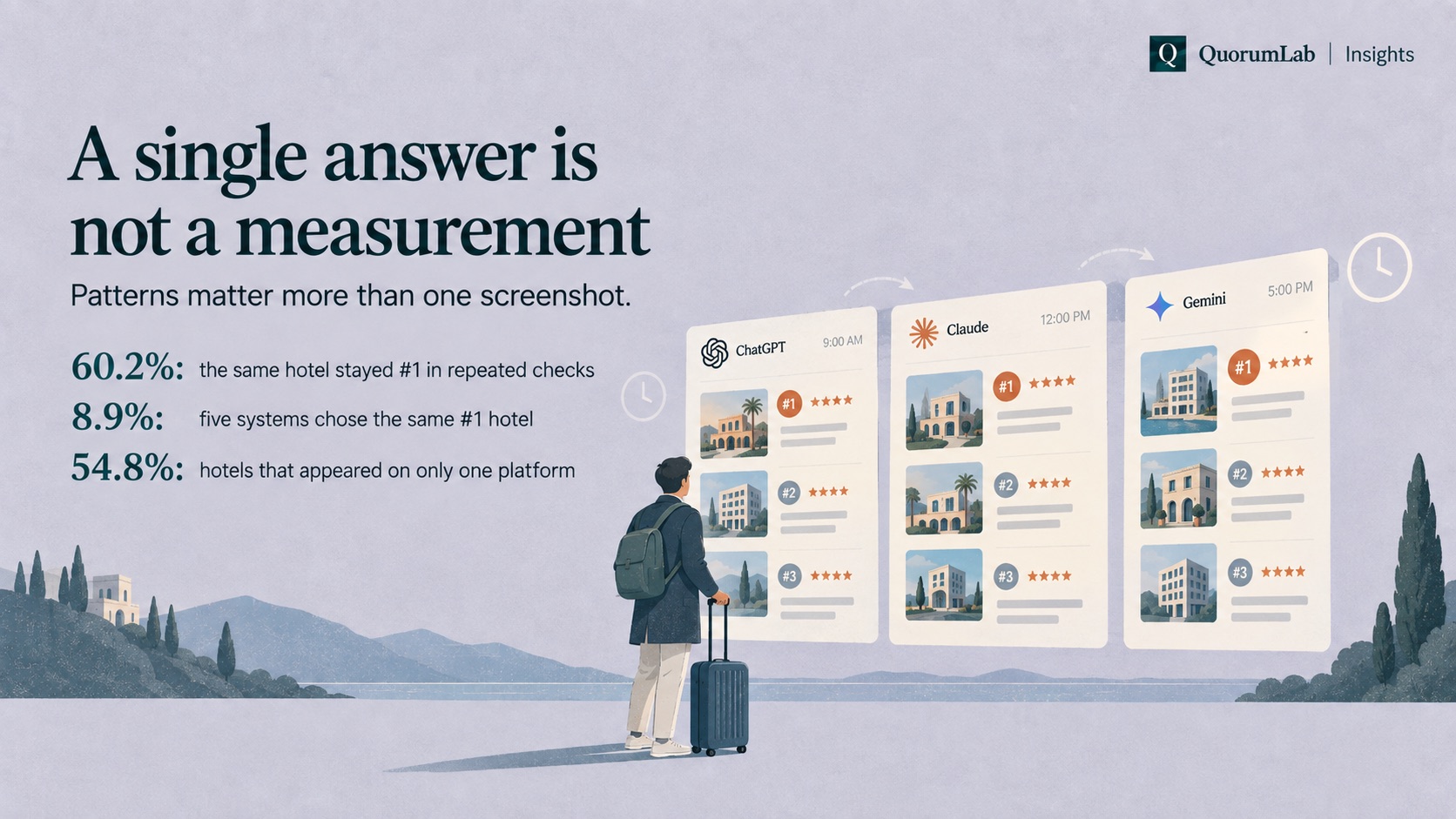
The words used by the traveller matter too. Searches for boutique, luxury and romantic hotels produced different competitive sets.
So an owner who asks ChatGPT one question, takes a screenshot and decides that the hotel “has good AI visibility” has learned very little.
The useful unit is a pattern: several relevant questions, several systems and repeated checks over time.
What should a hotel owner check?
A first review does not require a large technology project. Start with seven questions:
- Is the property named consistently across the places that matter?
- Is the relationship between the hotel, brand and operator clear?
- Is an old name still more visible than the current one?
- Do the address, category, contact details and important amenities agree across major sources?
- Do the official website and major online travel agencies describe the same property?
- Do language versions agree on the important facts?
- Does the hotel appear for non-branded questions that a real prospective guest might ask?
Do not only ask: “Tell me about Hotel X.”
Also ask: “Where should I stay in Cyprus if I want a quiet smaller hotel by the sea, with parking and a good breakfast?”
Then repeat the exercise. One answer is an observation, not a diagnosis.
Where QuorumLab fits
QuorumLab does not “optimise hotels for ChatGPT”.
The first task is measurement: what picture do AI systems produce when asked realistic traveller questions, and which parts recur?
Then comes the harder question: why?
Possible causes may sit in the property identity, hotel-brand relationship, old sources, the website, travel agencies, language versions or another part of the machine layer. A weak answer does not tell you which one is responsible.
When the task is clear, a specific intervention may be enough. When the symptom is visible but the cause is not, QuorumLab uses its Navigational Method: measure the current picture, map possible causes, change the controllable elements that have a sound basis for change, then measure again.
QuorumLab cannot control an external AI model or guarantee that a hotel will appear in a particular recommendation.
The useful question is narrower: does the machine see the hotel that actually exists?
Frequently asked questions
Why doesn’t ChatGPT recommend my hotel?
There is no single reason. The hotel may not appear in the sources retrieved for that question, may be weakly associated with the category or location, or may simply be left out of one answer. A single search cannot identify the cause. Repeated tests across realistic queries and several systems are needed.
Can AI confuse two hotels with similar names?
Ambiguity is possible, particularly when names, brands, locations or older versions overlap. But a similar name alone does not prove the cause of a specific error. Consistent naming and clear relationships between the property, brand and operator make the hotel easier to identify across systems.
Do reviews affect hotel visibility in AI?
Local Falcon found a strong association between Google review volume and how often hotels appeared in its AI tests. That does not establish causation. Hotels with many reviews may also differ in brand strength, demand and distribution. More reviews are not a guaranteed route to better AI visibility.
Will structured data make my hotel appear in AI recommendations?
There is no basis for guaranteeing that. Structured data can help systems interpret information on a website, but recommendation depends on much more than technical markup. A hotel can have a technically accessible website and still appear rarely in non-branded AI discovery.
How should a hotel measure AI visibility?
Use realistic traveller questions rather than one branded query. Test more than one AI system, repeat the same questions over time and separate branded searches from non-branded discovery. The goal is to find recurring patterns: where the hotel appears, where it disappears and which facts or associations remain stable.
The bottom line
Hotels have always competed to be found. AI adds a new step before the click.
For an independent hotel or regional group, the first question is no longer only whether the property ranks well on Google or performs well on an online travel agency.
It is whether the machine can work out which hotel it is looking at and whether that hotel belongs in the traveller’s shortlist at all.